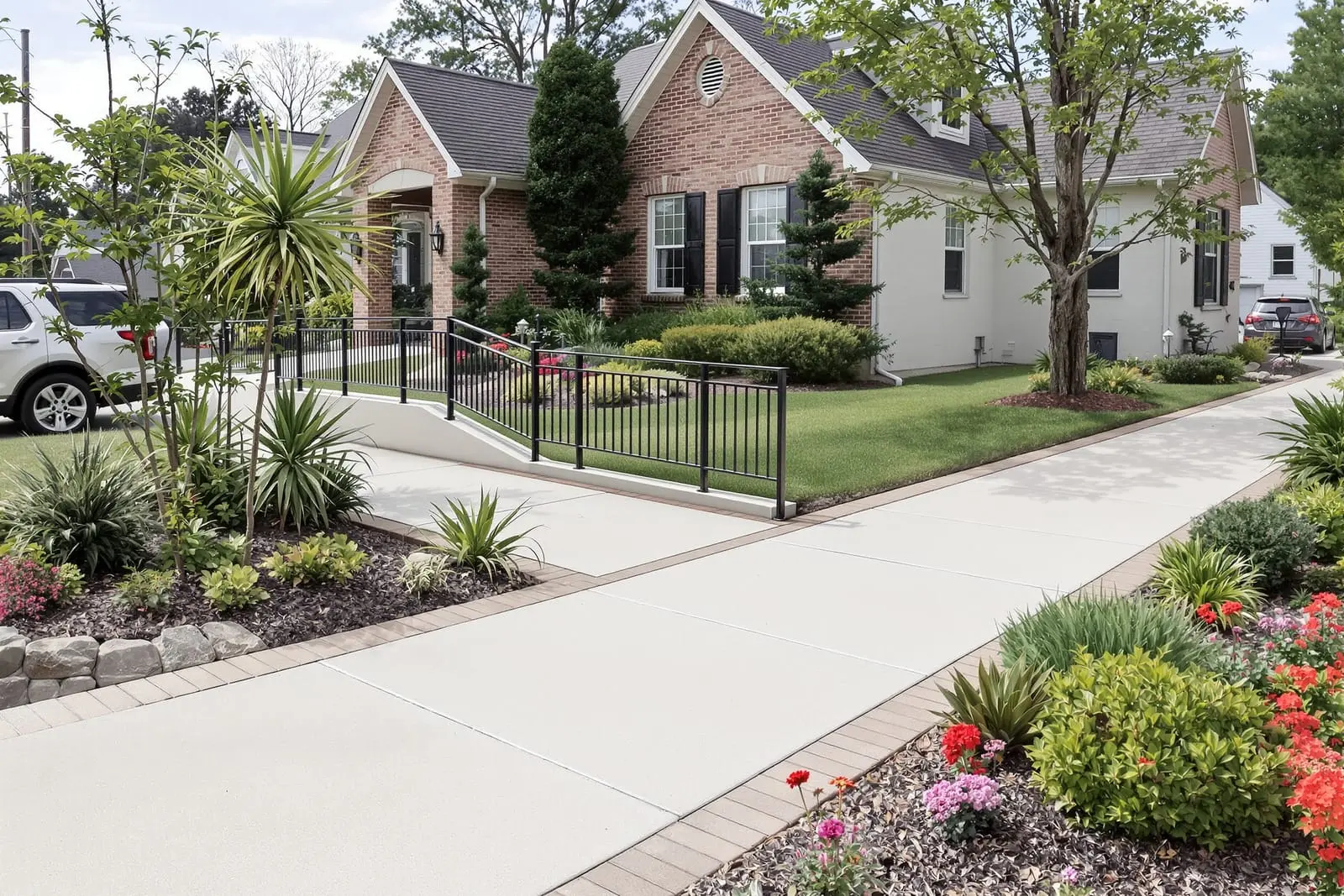
We provide commercial sidewalk installation in San Antonio, TX along with ADA compliant ramps and landings. Our team follows slope, width, and detectable warning requirements for safe pedestrian access. Improve accessibility around your building with durable concrete paths and ramp systems.
Vanguard Concrete San Antonio provides professional commercial sidewalk installation throughout San Antonio, TX and the surrounding area. Our licensed, insured crew delivers safe, clean, on-time work with a free estimate before anything begins. Call (726) 200-1600 or request your free quote.
Engineered Commercial Sidewalks and ADA Ramps in San Antonio
Vanguard Concrete San Antonio designs and installs commercial sidewalks and ADA ramps that are built for heavy use, Texas heat, and local code requirements. We focus on practical details that keep your property safe, compliant, and easy to maintain.
Every commercial sidewalk installation starts with how your site actually works. We walk the property with you, look at pedestrian traffic patterns, delivery routes, and drainage, then design flatwork and ramps that match the way people move across your property. Our goal is to eliminate trip hazards, standing water, and confusing access routes.
We routinely build sidewalks and ADA-compliant routes for office parks, retail centers, restaurants, medical buildings, schools, and industrial facilities around San Antonio. Whether you are adding a new building pad in the far West Side or upgrading an older plaza near downtown, we adapt the design to your soil conditions, slopes, and existing structures so the concrete performs for years, not just the first season.
Our Commercial Sidewalk Installation Process
A durable sidewalk or ADA ramp starts with proper preparation. We begin by calling in utility locates and verifying property boundaries so excavation and formwork stay within your easement and do not interfere with underground lines. Then we strip vegetation, old pavement, and unstable fill and proof-roll the subgrade to identify soft spots.
Subgrade is compacted in thin lifts using plate compactors or rollers to reach the density needed for our design load. In areas that were previously landscaped or where irrigation leaks have softened the soil, we often bring in select fill to stabilize the base. Skipping this step is why many sidewalks in San Antonio start to heave or settle after the first heavy rain.
We set forms with precise elevations and cross slope, usually 2 percent to shed water without creating a noticeable tilt for pedestrians or wheelchairs. For commercial sidewalks, we typically pour a 4 to 5 inch slab, and go thicker at drive approaches or where carts, pallet jacks, or light vehicle traffic cross. For ramps, thickness is often increased at landings and transitions to resist cracking at high stress points.
Before the pour, we place reinforcement based on the project needs. That may mean #3 or #4 rebar in a grid pattern, dowels into existing foundations, or fiber reinforced concrete where fine cracking is a concern. During the pour, we control mix consistency, vibration, and finish timing so the surface does not scale, dust, or develop low spots.
ADA Ramp Design and Compliance Details
ADA ramps are not just sloped sidewalks. To pass inspection and actually work for wheelchair users, walkers, and strollers, every measurement matters. Vanguard Concrete San Antonio follows ADA and TAS (Texas Accessibility Standards) guidelines, along with City of San Antonio requirements, for all accessible routes.
We verify slopes with digital levels before and after the pour. Running slope, cross slope, landing dimensions, clear widths, and handrail requirements are all calculated during design. Typical maximum running slope is 1:12 (8.33 percent), with flat landings at the top and bottom. Cross slopes are held to 2 percent or less so wheelchairs track straight without drifting.
Where ramps meet parking lots or streets, we install detectable warning surfaces using cast-in-place truncated dome panels or surface-applied units that meet color contrast and slip resistance rules. We coordinate elevation tie-ins with your paving contractor so there are no vertical lips at the joint that would fail inspection or cause complaints.
When retrofitting older properties, we look at existing grades first. Sometimes a single straight ramp will not fit, and we design switchback or L-shaped configurations with intermediate landings. We also help owners plan around tight spaces, existing utilities, or door swing clearances so improvements are functional and pass plan review the first time.
Concrete Mixes, Finishes, and Options for Heavy Use
San Antonio heat, sudden storms, and clay soils are rough on flatwork, so material choices have to match our climate. For most commercial sidewalk installation projects, we specify 3,000 to 4,000 psi concrete, often with air entrainment for exterior durability. In high traffic or loading areas, such as near loading docks or cart corrals, we may increase strength or add fiber reinforcement.
Finishes are chosen for safety first. A broom finish is standard for sidewalks and ramps because it provides excellent traction even when wet. Around building entrances and outdoor seating, we can tighten the broom or combine with a light trowel finish to balance appearance and slip resistance. For higher end projects, we offer integral color and scoring patterns that break up large slabs and help disguise future hairline cracks.
We pay close attention to joints. Too few control joints or poorly spaced panels are a common reason sidewalks fracture randomly. We typically cut joints at 4 to 6 foot intervals for walkways, or create a grid that respects building lines, column locations, and landscaping. Expansion joints are placed at fixed structures like building faces or staircases, with sealed gaps to accommodate movement.
Sealing is recommended in high traffic or stain-prone areas, like restaurant entries or medical offices. We use penetrating sealers that do not create a slick film but help resist deicing chemicals, oils, and daily washing.
What Drives Cost for Sidewalks and ADA Ramps
Vanguard Concrete San Antonio prices commercial sidewalk installation based on the real conditions on your site, not just square footage. The main cost drivers are access, thickness, reinforcement, grading complexity, and ADA requirements.
Access affects labor and time. If we can back trucks directly to the forms, costs stay lower. If everything must be pumped or buggyed around tight buildings or through operating plazas, labor and equipment time increase. Similarly, night or off-hours work to avoid disrupting customers can add to the budget but is often necessary in busy retail or healthcare settings.
Sidewalk thickness and reinforcement are tied to expected loads. A simple pedestrian path around an office may only need 4 inches of concrete with fiber. A sidewalk that doubles as a fire lane or delivery route might require 6 inches, heavier rebar, and a denser subbase, which increases concrete volume and steel cost.
ADA ramp complexity is another key factor. A short straight ramp off a new parking lot is straightforward. Retrofitting an older property with tight grades and multiple entrances can require additional demolition, handwork, and sometimes decorative retaining edges or guardrails to make the design work. We break these elements out clearly in our proposals so you see exactly what you are paying for.
Finally, unexpected conditions during demolition, such as hidden tree roots or abandoned utilities, can change the scope. We try to identify these risks during our initial site walk and discuss contingency options up front so you are not surprised later.
Local San Antonio Considerations: Soils, Drainage, and Heat
Concrete that lasts in San Antonio must be matched to local ground and weather. Our area has expansive clays in many neighborhoods, caliche in others, and sometimes a mix on the same site. Before commercial sidewalk installation, we look at existing cracking patterns on nearby pavement, irrigation layouts, and downspout locations to predict movement and water paths.
We build slope and drainage into every design, typically a 2 percent cross fall away from buildings and toward approved drainage points. Where sidewalks run along the front of retail bays or restaurants, we design to avoid low spots that collect water from roof scuppers or AC condensate. If needed, we incorporate surface drains or adjust grades slightly so pedestrians are not walking through puddles.
Heat and curing are also critical. In summer, fresh concrete in San Antonio can dry too quickly, which weakens the surface. We may pour earlier in the morning, use set-control admixtures, and always enforce proper curing. That can mean wet curing, curing compound, or a combination, depending on finish and specification. This step significantly reduces early shrinkage cracking and helps the surface resist scaling.
Tree roots are another local challenge, especially along street frontages. Where existing or planned trees run near new sidewalk, we adjust joint layouts, add root barriers when appropriate, and design base preparation to reduce the chance of slabs being lifted by roots a few years later.
How Vanguard Concrete San Antonio Manages Scheduling, Safety, and Operations
For active commercial properties, construction needs to be predictable and safe. We coordinate work windows with property managers and tenants so customers and staff can still move through the site. That may mean phased pours, temporary walkways, signage, and taping off curing sections.
Our crews follow defined traffic control and safety procedures, including barricades, caution tape, and spotters when backing equipment. On projects along busy streets or near school zones, we can coordinate with the City of San Antonio for any required right of way considerations.
Before we mobilize, you receive a clear schedule that outlines demolition, base prep, form inspection, pour day, and curing time. We also define when light foot traffic and heavier use can resume, so you can plan openings, deliveries, and events. For example, light foot traffic is often allowed after 24 hours, but heavy carts, pallet jacks, or vehicle loading may need several days.
At turnover, we walk the project with you, review joints, drainage, and accessibility features, and note any punch list items. You also receive basic maintenance guidance, such as when to pressure wash, what deicing products to avoid, and how to spot early issues so they can be corrected before they become costly.
“
Professional commercial sidewalks & ada ramps, done right the first time, quality materials, honest pricing, and results that last.
Vanguard Concrete San Antonio
Commercial Sidewalks & ADA Ramps Across Our Service Area