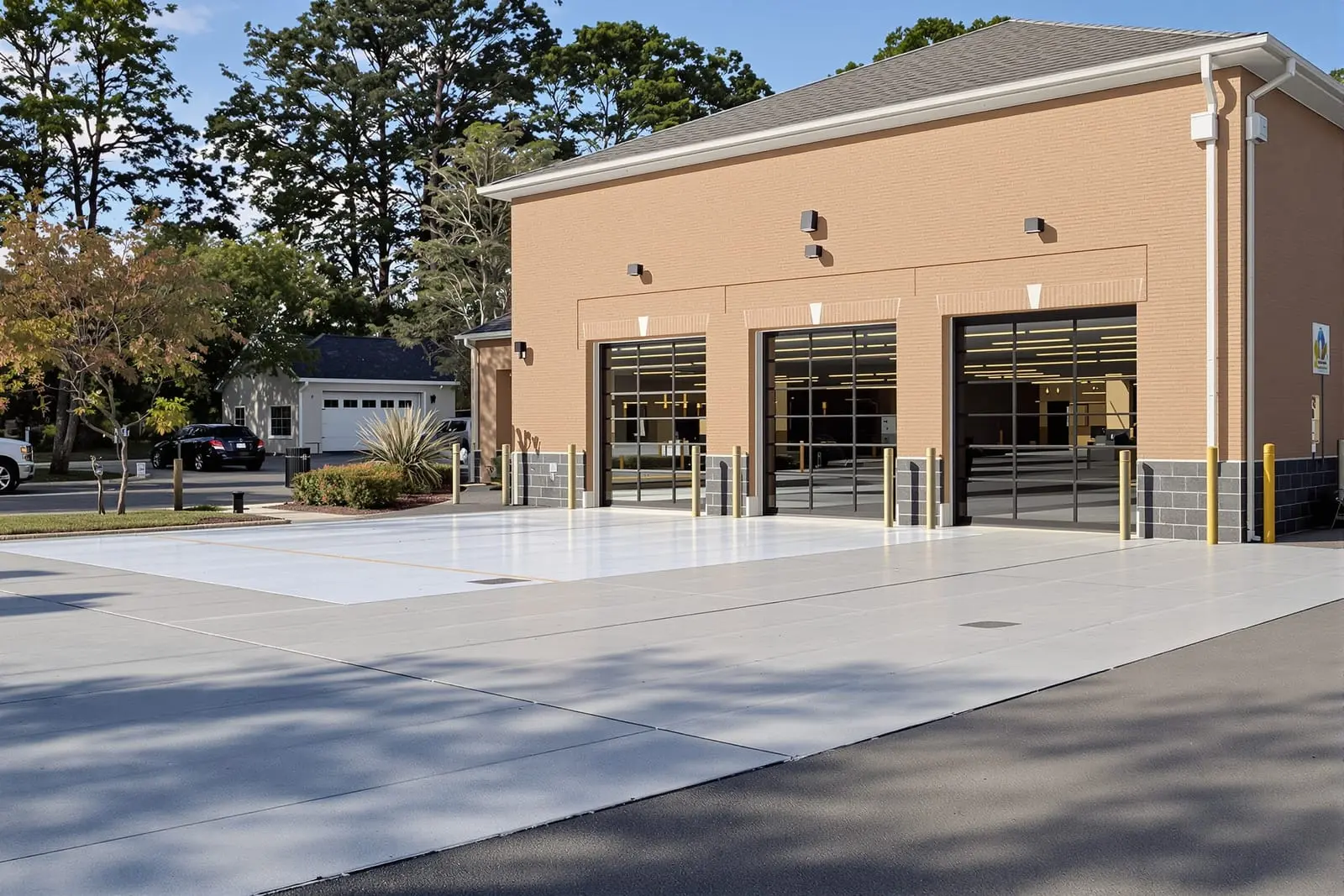
Keep operations moving with heavy duty commercial concrete slabs in San Antonio, TX. We build loading docks, equipment pads, and work areas to handle trucks and pallet jacks. Reinforced designs and proper elevations help match dock heights and door thresholds.
Vanguard Concrete San Antonio provides professional commercial concrete slab throughout San Antonio, TX and the surrounding area. Our licensed, insured crew delivers safe, clean, on-time work with a free estimate before anything begins. Call (726) 200-1600 or request your free quote.
Commercial Concrete Slabs Built for San Antonio Operations
Vanguard Concrete San Antonio designs and installs commercial concrete slabs and loading docks that match the way your business actually runs. Whether you move a few pallets a day or run continuous freight traffic, the slab under your operation has to carry that load, handle Texas heat, and stay serviceable for decades.
We work with warehouses, distribution centers, manufacturing facilities, cold storage, retail back-of-house areas, and small business loading pads across San Antonio. Before we talk thickness or reinforcement, we start with how you use the space: forklift weights, rack layout, dock leveler style, door locations, and future expansion plans. That information is what keeps a slab from cracking too soon or a dock from settling away from your building.
Because we live and work here, we design for San Antonio conditions. That means accounting for expansive clay pockets, heavy summer rains that undercut poorly drained slabs, and the way UV and heat cycles open small surface cracks. Our goal is not just to pour concrete. It is to build a surface that keeps product moving, trucks on time, and maintenance costs low year after year.
How We Design Loading Docks and Commercial Slabs
The design of a commercial concrete slab starts with evaluation of your soil and loads. Vanguard Concrete San Antonio checks soil reports if they are available, and if not, we perform on site probing and inspection. In many San Antonio areas, native clay needs to be moisture conditioned or replaced with compacted base to keep the slab from heaving or settling.
Next we confirm load requirements. We look at forklift axle loads, pallet rack leg loads, point loads from machinery, and any heavy truck traffic. For light commercial use, slabs might be 5 to 6 inches thick. For higher loads and dock areas, 7 to 10 inches with heavier reinforcement is often more appropriate. We make those recommendations in writing so you know exactly what you are getting.
For loading docks, we coordinate slab elevations with your building door thresholds and the types of trucks you receive. A common issue we fix is docks that were poured a few inches too low or high, which makes levelers work too hard and causes premature failure. We design slopes toward trench or area drains so water moves away from the building, but we keep grades comfortable for pallet jacks and forklifts.
Reinforcement is tailored to the use. Wire mesh is sometimes sufficient for light duty slabs. For dock aprons, high traffic lanes, and inside warehouse slabs, we typically specify rebar on a grid or fiber reinforced concrete placed at the correct depth, not just thrown into the mix.
Our Step by Step Build Process
A solid commercial concrete slab comes from how it is built, not just the mix ticket. Vanguard Concrete San Antonio follows a defined process so you know what will happen on your site.
1. Layout and elevation checks. We verify property lines, building control lines, dock door heights, and finished floor elevations. We also confirm clearance for trailers, dock bumpers, and overhead doors.
2. Excavation and base preparation. We remove unsuitable soil, vegetation, old concrete, or soft spots, then install compacted base material, usually crushed limestone or flex base common in this region. We compact in layers and perform plate compaction checks where required.
3. Formwork and isolation. We build forms to the exact slab thickness and slope. At loading docks we install isolation joints between the dock slab and the building foundation so that truck impact does not transfer into your structure.
4. Reinforcement placement. Rebar or mesh is set on chairs at the specified spacing and kept off the ground. At dock edges and door openings we often thicken the slab and tighten the rebar pattern to resist chipping and corner breaks.
5. Concrete placement and finishing. We order commercial mixes with the right compressive strength, typically 4,000 to 5,000 psi or higher for heavy duty docks, and use low water to cement ratios to control shrinkage. We place concrete to avoid cold joints, use straightedges and screeds to get accurate flatness, then finish the surface depending on use, commonly a broom finish outside and machine trowel inside.
6. Joint cutting and curing. Control joints are saw cut on a pattern suitable for the slab dimensions and load, usually within 6 to 18 hours, before random cracking can start. We apply curing compound or use wet curing to help the slab gain strength evenly, which is critical in San Antonio heat.
Special Considerations for San Antonio Loading Docks
Local conditions around San Antonio create a few recurring issues for loading docks and commercial slabs that we design around from day one.
Expansive clay soils in many neighborhoods expand when wet and shrink when dry. If a dock apron is poured directly on poorly compacted or untreated clay, it can lift and sink with the seasons, pulling away from the building or cracking around joint lines. Vanguard Concrete San Antonio uses proper subgrade preparation, moisture control, and sometimes increased base thickness or rebar dowels to minimize that movement.
Storm events in this region can quickly overwhelm undersized drainage. Docks that were poured flat or sloped back toward the building often collect water at the doors, which finds its way inside or undermines the slab edge. We design positive fall away from the building, integrate trench drains where needed, and tie those drains into existing systems or new outfalls that meet local code.
Sun and heat also affect surface performance. At docks that see frequent metal track and tire traffic, we can specify surface hardeners, sealed surfaces, or a slightly coarser broom finish for better traction in wet weather. We also talk through realistic curing times so heavy trucks are not placed on green concrete too early, which is a common reason for surface scaling in this area.
Cost Factors and How to Control Your Budget
The cost of a commercial concrete slab or loading dock project in San Antonio depends on several specific factors, and we walk you through each one before work begins.
The largest cost drivers are slab thickness, total square footage, reinforcement type, and base preparation. For example, upgrading from a 6 inch to an 8 inch slab with tighter rebar spacing for high forklift loads increases concrete and steel usage, but may save you from replacing a failed slab later. Poor existing soil that needs excavation and additional base material is another major component.
Access to the site matters. If trucks can back right up to the pour area, concrete delivery is more efficient and costs stay lower. If we have to pump over a building or work in tight downtown alleys, pumping and labor costs increase. Schedule can also affect price. Night or weekend work to keep a facility running may add labor, but many local clients find that worth it to avoid shutting down operations.
Vanguard Concrete San Antonio helps control your budget by separating must have structural items from optional upgrades. For example, you might choose standard reinforcement and thickness for the main warehouse slab, but invest in thicker slab and better drainage in dock bays and high impact areas. We provide itemized proposals so you can see how each design decision affects cost.
Repair, Replacement, and Expansion of Existing Slabs
Many of our commercial projects in San Antonio involve fixing or extending existing loading docks and slabs rather than building new from scratch. If you have cracking, settlement at the dock lip, spalling at joint lines, or ponding water, we start with an onsite assessment to determine whether targeted repair or full replacement makes more sense.
For slabs that still have a stable base, we may sawcut and replace failed panels, add dowels to tie new concrete to old, and improve joint details to prevent the same damage from recurring. Dock aprons that have dropped away from the building can sometimes be lifted with grout or foam injection if the base is sound, or replaced entirely if the soil or drainage is the real problem.
When expanding a warehouse or adding dock positions, we match new slab thickness, elevation, and finish to your existing floor so forklifts cross seamlessly. We also look at the opportunity to upgrade old designs, such as increasing reinforcement at door openings for new dock levelers or deepening the apron where trailer landing gear is causing punch through.
Our team coordinates with your operations so shutdown time is minimized. For many local facilities, we phase work so that some docks stay open while others are being reconstructed, and we schedule heavy demolition away from peak receiving hours.
Why Local Experience Matters and How to Get Started
Commercial concrete slabs and loading docks are not one size fits all, especially in a market like San Antonio with a mix of older industrial areas and rapidly growing distribution hubs. Working with Vanguard Concrete San Antonio means your project is handled by a contractor that understands local soils, codes, and the day to day realities of moving freight in this region.
We keep communication straightforward. Before work starts you receive a clear scope, slab design details, reinforcement schedule, and a projected timeline. During construction you have a direct contact who updates you on each phase and coordinates around your deliveries or tenant needs.
If you are planning a new facility, adding dock positions, or dealing with slab issues that are slowing down your operations, we can meet you on site anywhere in the San Antonio area to review options. We walk the space with you, ask about your equipment and traffic patterns, and then provide practical recommendations instead of generic templates.
Reach out to Vanguard Concrete San Antonio to schedule a consultation for your loading dock or commercial concrete slab project, and get a design that is built for your building, your traffic, and San Antonio conditions.
“
Professional loading docks & commercial slabs, done right the first time, quality materials, honest pricing, and results that last.
Vanguard Concrete San Antonio
Loading Docks & Commercial Slabs Across Our Service Area